
Article #4 How to Find Workflow Bottlenecks in a Small Business
Article #2
How to Find Workflow Bottlenecks in a Small Business
When work keeps piling up, customers wait longer than expected, or the owner constantly has to jump in to keep things moving, it's tempting to jump straight to a solution.
Hire another person. Add automation. Buy better software. Create another procedure.
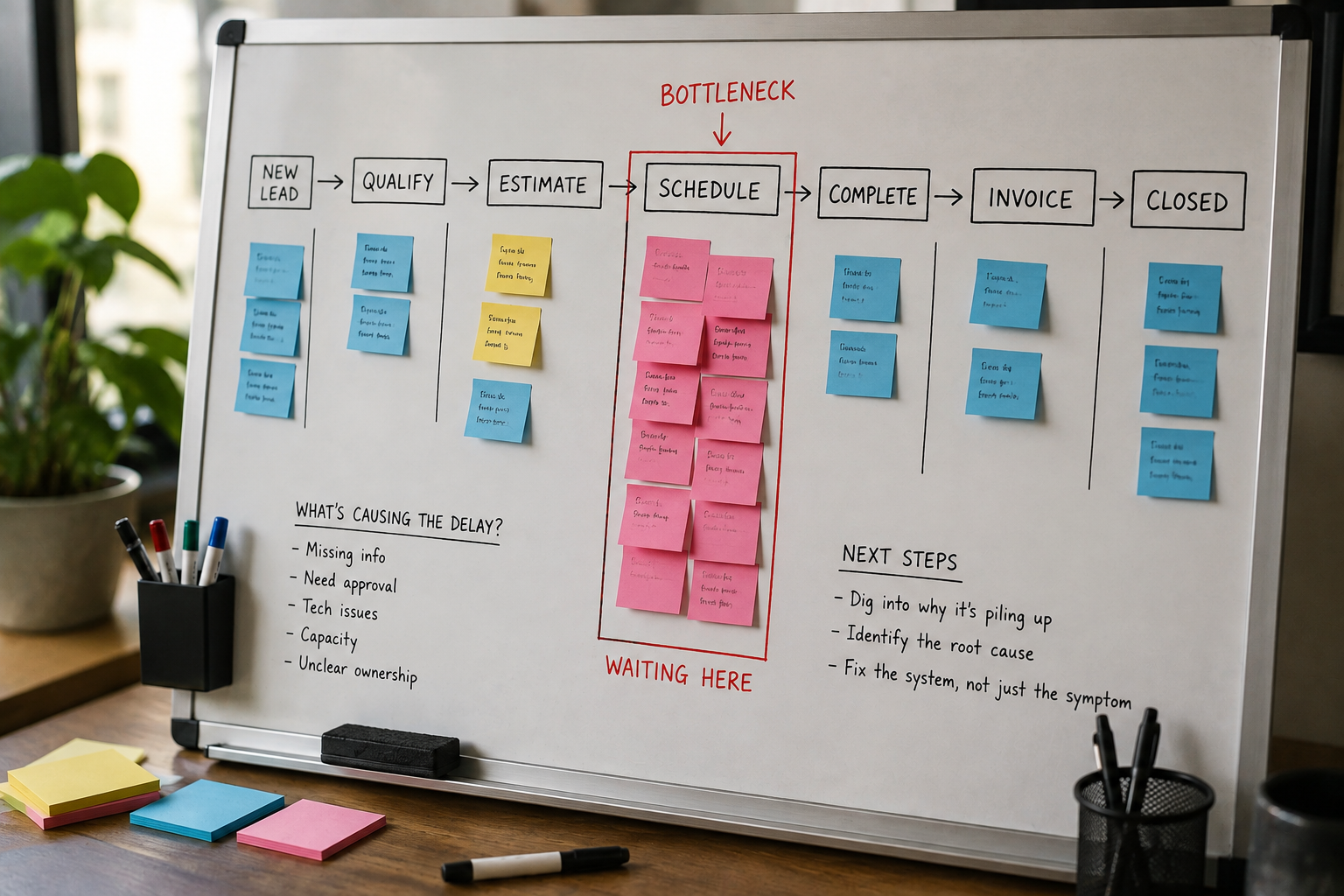
But before deciding how to fix a bottleneck, you need to know where the work is actually getting stuck—and why.
A bottleneck isn't always the busiest person or the slowest task. Sometimes the real constraint is a handoff, missing information, an approval, unclear ownership, or work simply waiting for someone to notice it.
Finding the bottleneck first helps you solve the right problem.
What Does a Workflow Bottleneck Look Like?
Bottlenecks usually show up as patterns rather than one dramatic failure.
Watch for things like:
Work repeatedly piling up at the same stage.
The same delays occurring again and again.
One person becoming a constant dependency for approvals, information, or decisions.
Long gaps between steps, even when the actual work doesn't take very long.
One employee or role consistently carrying a larger queue than the rest of the process.
Customers repeatedly asking for updates because work has stalled or its status isn't visible.
Work moving quickly through some stages but slowly through another.
One occurrence doesn't necessarily mean you've found a bottleneck.
Look for recurring patterns.
That's where useful diagnosis begins.
Start With One Workflow
Trying to analyze the entire business at once can create more confusion than clarity.
Instead, choose one workflow where you're already seeing a recurring problem.
For example:
New inquiry → estimate
Estimate → scheduled job
Payment → customer onboarding
Completed work → invoice
Customer issue → resolution
Then trace that workflow from its starting trigger to its final outcome.
For each stage, identify:
What happens → Who owns it → What information is needed → What triggers the next step
You're not trying to redesign anything yet.
You're trying to see what actually happens.
Look at Where Work Waits
One of the most useful distinctions is the difference between work time and waiting time.
Suppose preparing an estimate takes 30 minutes.
If the estimate regularly sits untouched for three days before someone starts it, the 30-minute task may not be the real problem.
The waiting is.
Look at each stage and ask:
How long does the actual work take?
How long does it typically wait before someone starts?
What is it waiting for?
Does someone know it's ready?
Is required information missing?
Is another person or approval required?
This helps separate a difficult task from a workflow that simply isn't moving.
Examine Ownership
Work can also stall because nobody is completely sure who owns the next action.
Ask one simple question at each stage:
Who is responsible for moving this forward right now?
If the answer is “everyone,” “it depends,” or “usually someone from the office,” investigate further.
Ownership doesn't have to remain with the same person throughout the workflow.
But it should be clear at each stage.
When ownership changes, the handoff should make that transfer obvious.
Look Closely at Handoffs
Handoffs are natural places for bottlenecks to form because work, information, and responsibility are all moving at the same time.
Sales hands a new customer to operations.
An estimator hands an approved project to scheduling.
Field work moves to billing.
Customer service escalates a problem.
At each handoff, ask:
What has to be completed before the handoff?
What information needs to move with the work?
Who receives it?
How do they know it's ready?
What confirms that they now own the next action?
If someone regularly has to chase information, ask what happened, or reconstruct context, the delay may be in the handoff rather than the task that follows it.
Is It Really a Capacity Problem?
A growing backlog often leads to one immediate conclusion:
We need another person.
Sometimes that's correct.
But a backlog alone doesn't prove you have a capacity problem.
Look at what is creating the queue.
If someone has organized, ready-to-complete work arriving faster than they can reasonably complete it, you may have a genuine capacity constraint.
But if their queue is filled with incomplete requests, missing information, rework, unclear priorities, unnecessary approvals, or work that shouldn't have reached them yet, adding another person may not solve the underlying problem.
The question isn't simply:
“Is this person busy?”
It's:
“Why is work accumulating here?”
That distinction can save a business from adding cost without fixing the constraint.
Watch for Owner Bottlenecks
Sometimes the constraint is the owner.
That doesn't automatically mean the owner needs to “let go” or delegate everything.
Look at why work keeps coming back to them.
Does the owner have information nobody else has?
Are approval limits unclear?
Are employees unsure which decisions they can make?
Does the workflow require an owner signature or review that no longer adds much value?
Or is the owner's involvement genuinely necessary?
Diagnose the dependency before removing it.
If the owner is providing something essential, the solution may be different from a situation where work is waiting simply because decision authority was never clearly defined.
Follow the Pattern to the System Cause
Once you've identified where work repeatedly slows down, don't stop at the location of the bottleneck.
Ask why it's happening.
For example:
Symptom: Estimates are delayed.
Pattern: Estimates repeatedly wait after site visits.
Possible system cause: Required field information isn't consistently captured before the estimator receives the job.
In that situation, hiring another estimator might increase capacity without fixing the missing-information problem.
Another example:
Symptom: Customer onboarding takes too long.
Pattern: New accounts repeatedly wait for owner approval.
Possible system cause: Nobody has defined which onboarding decisions employees can make without the owner.
Now the conversation isn't simply about “speeding up onboarding.”
You're diagnosing what is creating the delay.
Choose the Fix After You Understand the Cause
Once you understand the bottleneck and what's creating it, then you can decide what should change.
The answer might be:
Clearer ownership
A stronger handoff
Better information capture
Removing an unnecessary step
A checklist or standard
Better visibility
Training
Automation
Different technology
More capacity
A staffing change
The solution depends on the cause.
That's why jumping directly from problem → fix can be expensive.
A better sequence is:
Outcome → Pattern → System Cause → Solution
Understand what is happening. Find the recurring pattern. Determine what's causing it. Then choose the intervention.
Fix the Constraint, Not Just the Symptom
Workflow bottlenecks create visible problems: delays, backlogs, customer frustration, employee overload, and constant owner involvement.
But those symptoms don't tell you what solution to buy.
Trace the work. Look at waiting time. Examine ownership and handoffs. Follow recurring patterns until you understand what's creating the constraint.
Then fix that.
The Unseen Step helps small service businesses identify where work is getting stuck, understand what's causing it, and determine what needs to change first.